The project
successfully elaborated a joint formal model of cognitive
assessment of learning progress (on the basis of Competence-based
Knowledge Space Theory) on a probabilistic and non-invasive
level, of non-invasive motivational assessment, the
provision of suitable support and interventions, and
open interactive adaptive storytelling (cf. Kickmeier-Rust,
Hockemeyer, Albert, & Augustin, 2008). From a technical
point of view, within the project an accurate analysis
of learning and game design requirements has been carried
out and the results have constituted the starting point
for the study on system architectures and software modules
that best could have fulfilled the requirements. Research
in the area of open, interactive storytelling achieved
a technical realization of the developed formal model
in form of a story engine, which implements the psycho-pedagogical
model and which drives and adapts the game (Kickmeier-Rust,
Göbel, & Albert, 2008). Overall, psycho-pedagogical
and technical efforts led to a compelling prototype
game. Significantly, this demonstrator also represents
an important step towards achieving a multi-adaptive
system that not only adapts discrete elements of the
game towards psycho-pedagogical purposes, but also adapts
the story to accommodate larger educational objectives.
Very briefly, the prototype game is teaching geography
for a target audience of 12 to 14 year olds and follows
European curricula. The game design includes premises,
concepts, metaphors, structures, gameplay, learning
objectives, contents, background story, game characters,
visual design and game props. In concrete terms, an
adventure game was realized within which the learner
takes the role of an Earth kid at the age of 14. The
game starts when a spaceship is landing in the backyard
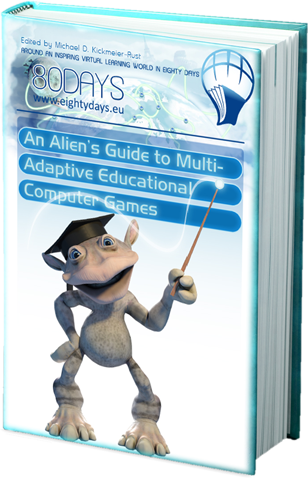
and an alien named Feon is contacting the player. Feon
is an alien scout who has to collect information about
Earth. Subsequently player and Feon have to explore
Erath and learn facts as well as concepts in order to
successfully proceed through the game.
During the project’s
three development phases, the game was subject of multi-facetted
evaluation activities. This work was geared towards
its objectives of defining an evaluation framework and
of implementing an array of evaluative activities. In
close collaboration of different disciplines, the game
design concepts and adaptive features were investigated
with children from Austria, Germany, and the United
Kingdom. Empirical findings yielded beneficial effect
of playing the game, as evident and an overall satisfying
usability and user experience. Implications for the
future development of the game prototypes and the design
of evaluative activities were drawn. In particular,
the theoretical knowledge and practical experience thus
gained will contribute to advancing the research area
of evaluating usability and user experience in digital
educational games.
An, ultimately, this leads
to the purpose of the guide book. In the following sections
we want to introduce the idea (the necessity) of personalizing
educational gaming, the theoretical concepts and ideas,
as well as the scientific, conceptual solutions developed.
We want to share our experiences in educational game
design, which can be considered more than being the
sum of good learning design and good game design, and
we want to present a role model for a successful curriculum-related
design. In essence, we want to provide a set of ideas,
experiences, and solutions to guide the reader through
the process of designing and developing the next generation
of educational computer games.
Table of Contents
Around an Inspiring Virtual Learning
World in Eighty Days 1
Designing Learning Games 5
Soil: The Zeitgeist that teaches Geography
6
Roots: The Premises of the Game 7
Why do we Need premises for Designing a Learning Game?
8
Premises Set the Goals of a Learning Game 8
The Premise for Learning Geography 10
The Premises for Story and Gameplay 11
Log: The Game Metaphor 12
What is a Game Metaphor? 12
The Game Metaphor for 80Days: The “Long Zoom”
14
The intention of the Game Metaphor for the Didactic
Design 14
The intention of the Game Metaphor for the Game Design
15
Crown: The Game Concept 15
Goals 16
Structure 16
Content 17
Apple & Picker: The Learning Game Situation 19
Challenges of Learning Game Design 20
Game Metaphor 20
Game Concept 20
Design Learning Game Situations 21
Developing Educational Games 23
Videogames Development 24
General Overview of Videogames Development 24
The Process of Videogame Creation 25
The Development Team 26
Videogames and Learning Games 27
Common Approaches at Learning Games Development 28
The 80Days Approach 31
Game Engine Choice 34
Engines integration 37
Game engine Architecture 38
Rendering Engine: Nebula2 39
Game Engine Core: Mangalore and the Core Application
41
Scripting Engine 42
Story Engine Interface 42
External Modules 44
Development Pipeline 46
Balancing on a High Wire: Adaptivity
Key Factor of Future Learning Games 51
Competence-Based Adaptation 53
A theoretical Basis for Competence-Based Adaptation
53
Macro Adaptivity: Pinpointing Challenge and Learning
Sequence 57
Getting Storytelling on board: Linking Story and Knowledge
58
Micro Adaptivity: Taking a Back Seat with Sensitive
Antenna 60
Non-invasive Competence Monitoring 61
Non-invasive Guidance 63
Motivational Adaptation 75
Motivation in Learning Games 78
Assessing motivation 83
Approaches to Motivational Assessment 83
Motivational Adaptation in Learning Games 89
Conclusion 102
Adaptive Digital Storytelling
for Digital Educational Games 109
Interactive Digital Storytelling 111
Story Forms – Sequencing in DEG 113
Hero’s Journey as Red Thread in 80Days 115
Learning 117
Gaming 118
Narrative Game-Based Learning Objects 119
Authoring 121
Creating a Story 123
Constructing the Story Structure 124
Configuring Stages 124
Defining Actions in Scenes 125
Testing, Iterative Design 126
‘Bat Cave’ Testing and Evaluation Platform
127
Conclusion 128
Realizing Just-in-Time Personalization
– A Technology Overview 129
Challenges in Realizing Personalized
Digital Game–based Learning 130
Introducing the Story Engine and Learning Engine 134
The Four-Stage Approach to Just-in-Time Personalization
136
The Skill Assessment Engine 137
The Motivation Assessment Engine 140
Personalizing the Story 142
Story Description Language – ICML 142
Story Engine 143
Cooperation between the Story Engine and Learning
Engine 145
Meeting the Challenges of Game-based Learning 146
Integrating External Content:
A Possibility to Reduce Development Costs 149
Costs of Developing DEGs 150
Integrating External Resources: A Possibility to Reduce
Costs of DEGs 151
Using Geographic Datasets for the Generation of a
Virtual Environment 152
Premises 152
Data Selection 155
Virtual Terrain Generation 161
Integrating Existing External Content in Order to
Save Content Production Costs 164
Premises 164
Data Selection 165
Integration in the DEG 166
Evaluation and Validation Methodologies
for Adaptive Digital Educational Games 169
EVADEG: Four-Dimensional Framework 174
Learning Effectiveness Validation (LEV) 175
Game Usability Evaluation (GUE) 177
Participatory Design (PD) 178
Expert Review 179
User Tests 179
Game Experience Evaluation (GEE) 182
Game Experience Conceptual Models 182
User Experience Evaluation Methods 183
Realtime Interaction Trajectory for Adaptivity Evaluation
(RITAE) 185
Special Evaluation Technique: Eye-Tracking 187
Specific Analytic Framework: Activity Theory 188
Concluding Remarks 191
|